Drying out wet building materials isn’t just about running fans or waiting for warm weather. Inside a home, moisture moves according to predictable scientific laws—and understanding those laws is the key to preventing mold growth, structural damage, and long?term indoor air quality issues. Whether the problem is in an attic, crawlspace, wall cavity, or subfloor, the physics behind drying is always the same: moisture must migrate from deep inside the material to the surface, and then evaporate into the surrounding air.
Below are the core scientific principles restoration professionals rely on when drying a home.
1. Moisture Migration: How Water Moves Inside Wood, Drywall, and Concrete
Research shows that moisture moves through building materials in two primary ways: capillary flow and vapor diffusion.
Capillary Flow (Early Stage Drying)
When materials are freshly wet, liquid water travels through tiny pores and pathways—similar to how a paper towel absorbs a spill. This stage is fast because the material still contains continuous liquid networks. In softwoods, capillary flow can move moisture at measurable rates of 0.5–2.0 mm per minute, depending on pore size.
Vapor Diffusion (Late Stage Drying)
As materials dry, those liquid pathways break down. Moisture remains only as vapor inside the pores, and movement slows dramatically. Vapor diffusion follows Fick’s Law, meaning moisture moves from areas of high concentration to low concentration. Diffusion coefficients drop significantly as materials dry—one study showed a decrease from 2.5×10?? m²/s at 30% moisture to 3.0×10?? m²/s at 10% moisture.
This is why the last 10–15% of moisture removal always takes the longest.
2. Evaporation: The Rate?Limiting Step
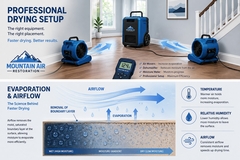
Even if moisture reaches the surface quickly, it still must evaporate into the air. Evaporation depends on:
-
Temperature (warmer air holds more moisture)
-
Relative humidity (dry air accelerates evaporation)
-
Airflow across the surface (removes saturated boundary layers)
-
Material thickness and porosity (affects migration speed)
Drying models used in building?science research consistently show that temperature and humidity of the drying air are the dominant factors controlling evaporation rates.
3. Why Some Materials Dry Faster Than Others
Different building materials respond differently to moisture:
-
Wood: Highly porous, dries relatively quickly but is prone to shrinkage and cracking if dried too fast.
-
Brick & Concrete: Dense materials with slow diffusion rates; require longer drying cycles.
-
Drywall: Absorbs moisture rapidly but loses structural integrity when saturated.
A review of drying applications across wood, brick, and concrete confirms that each material requires tailored drying conditions to avoid damage such as cracking, deformation, or case hardening.
4. Why Controlled Drying Matters in Homes
Uncontrolled drying—simply waiting for warm weather or relying on natural ventilation—can lead to:
-
Mold growth during slow drying phases
-
Structural damage from prolonged moisture exposure
-
Higher remediation costs if mold spreads
-
Indoor air quality issues as spores migrate into living spaces
Modern building?science tools like Wufi Pro, CFD modeling, and TRHumidade simulate moisture movement inside materials and confirm that active drying is necessary to reach safe moisture levels in a predictable timeframe.
5. The Restoration Approach: Using Science to Dry Homes Safely
Professional drying follows the physics—not guesswork. A proper drying plan includes:
-
Moisture mapping to identify wet materials
-
Temperature control to increase vapor pressure
-
Dehumidification to lower ambient humidity
-
Airflow management to remove saturated boundary layers
-
Monitoring to ensure materials reach equilibrium moisture content
This scientific approach prevents secondary damage and ensures the home returns to a stable, healthy condition.
Bottom Line
Drying isn’t just “waiting for things to dry.” It’s a controlled scientific process involving moisture migration, vapor diffusion, and evaporation kinetics. When building materials get wet, the safest and most cost?effective solution is active, science?based drying—not hoping nature takes care of it.